On this page16 sections
- Why payment apps show your real name
- What each app shows
- Venmo
- Cash App
- PayPal and PayPal.Me
- How a reused handle leads to a real name
- Real cases: Venmo and the White House
- Why it matters
- How to lock it down
- Check what your handle connects to
- FAQ
- Does Venmo show your real name?
- Is my Cash App $Cashtag public?
- Can someone find me from my PayPal.Me link?
- Can someone find my real name from my username?
- How do I stop people finding me on payment apps?
Payment apps verify who you are, then show your name next to a handle you picked. If that handle is also your gamertag, Reddit username or anonymous account, anyone who searches it can get from the alias to a real name in a few minutes. Nothing gets hacked. Every step uses information the apps display on purpose.
This post covers what Venmo, Cash App and PayPal show to other people, how a reused handle links accounts together, real cases where it happened, and how to lock each app down.
Why payment apps show your real name
Before you send money, you want to know it's going to the right person. So payment apps show the recipient's name before you pay, and let you look people up by handle, phone number or email.
That name is usually real. Cash App, for example, asks for your full legal name, date of birth and Social Security number at signup, then uses your legal name as your profile name. The handle next to it is whatever you typed, and many people type the same one they use everywhere else.
What each app shows
| Venmo | Cash App | PayPal / PayPal.Me | |
|---|---|---|---|
| Handle | @username | $Cashtag | Username and paypal.me link |
| Name shown | First and last name | Legal last name; first name can be a preferred name | First and last name, or business name |
| Who can see the profile | Anyone on the internet | Anyone on Cash App | PayPal users; a PayPal.Me page is public |
| Other details | Photo, month and year you joined, public payments, friends list | When you joined, past payments with the viewer, mutual contacts | Photo, city, and depending on settings email, phone and account age |
| Main control | Payment and friends-list privacy, Find Me | "How others find you" | Search privacy, turning off PayPal.Me |
Sources: each app's privacy policy and help pages, linked below. Checked October 2026.
Venmo
Venmo's privacy statement lists your username, profile photo, first and last name, the month and year you joined, and your public transactions as public information that "may be seen by anyone on the internet, whether or not they have a Venmo account." Your friends list is visible to any logged-in Venmo user unless you change it.
Payments set to Public or Friends share the note, both names and the timestamp, though dollar amounts are hidden. After Venmo's May 2026 redesign, a Venmo spokesperson said new accounts default to Friends only. Accounts were public by default for years before that, so older accounts are worth checking.
The friends list is the bigger leak. A few hundred names map out someone's family, roommates and coworkers, and public payment notes like "rent" or "Tuesday league" fill in the rest.
Cash App
Cash App says plainly: "Your $cashtag is public." People can search for you by name, $Cashtag, phone number or email.
Your profile name starts as your legal first and last name. You can swap the first name for a preferred one, but the last name "always matches your legal last name", and by default anyone on Cash App can find you by it. When someone goes to pay you, the privacy notice says Cash App may also show them when you joined, past transactions between you, and how many of their contacts have paid you.
So if your $Cashtag matches your gamertag, searching that gamertag in Cash App shows your real last name.
PayPal and PayPal.Me
PayPal lets other PayPal users find you by name, email, phone or username. It was opt-out: accounts became searchable on September 5, 2023 unless the owner changed the setting. Depending on your settings, PayPal's privacy statement says other users may see your photo, name, email, phone number, city and state, and the month and year you opened the account.
A PayPal.Me page is built to be shared. Per its terms, it shows your name or business name, profile picture and the city on your PayPal account. Old PayPal.Me links in a Twitch panel, a marketplace listing or a forum signature keep pointing at that page for years.
PayPal and Venmo users can now find each other too, which is why Venmo's Find Me setting has a separate "On PayPal" toggle.
How a reused handle leads to a real name
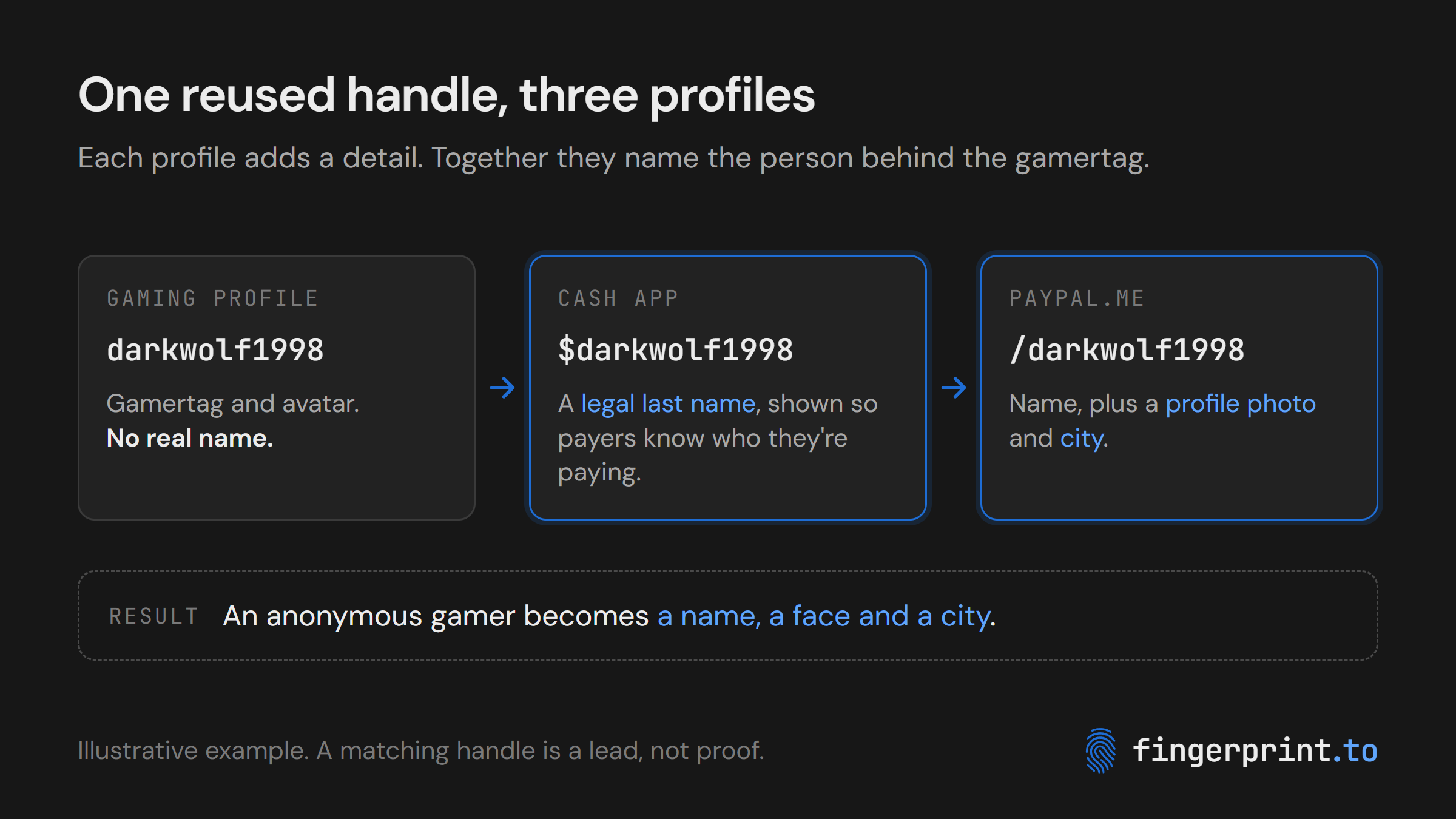
Say someone plays as darkwolf1998 and also uses $darkwolf1998 on Cash App. A person they argued with in a lobby searches the handle, finds the Cash App profile and gets a real last name. A PayPal.Me link under the same handle adds a photo and a city. With a name, a face and a city, the rest of that person's social media is usually one more search away.
A matching handle is only a lead. Common handles collide, and darkwolf1998 could be several different people. What turns a lead into an identification is corroboration across profiles:
- the same profile photo or avatar
- direct links between accounts, like a bio that links to a PayPal.Me page
- a consistent location, age (the "1998") or time zone
- overlapping friends, followers or payment contacts
- account creation dates and writing style that line up
If you're investigating, record each signal with its source, and write down anything that cuts against the match too.
Real cases: Venmo and the White House
- May 2021: BuzzFeed News found President Joe Biden's Venmo account in under 10 minutes, using Venmo search and public friends lists. Weeks later, Venmo let users hide their friends list.
- July 2024: WIRED reported that JD Vance had left his Venmo public.
- February 2025: The American Prospect found Defense Secretary Pete Hegseth's friends list was public, though his transactions weren't.
- March 2025: WIRED found that national security adviser Mike Waltz, chief of staff Susie Wiles and other top officials had left their Venmo friends lists public. The next day it found four more accounts tied to officials in the Signal group chat.
None of these needed special tools. If the national security adviser missed a privacy setting, most people have too.
Why it matters
Real details make fake stories believable. A scammer who knows your name, your friends' names and your payment handle can pose as someone you trust, or as you. The FTC reported in April 2026 that nearly 30% of people who reported losing money to a scam in 2025 said it started on social media, with reported losses of $2.1 billion.
For stalking and harassment, the risk is simpler. A name and a city are often enough to find where someone lives.
How to lock it down
Venmo (Me > Settings > Privacy)
- Set your default payment privacy to Private, and hide past payments.
- Set your friends list to Private.
- Under Find Me, turn off the "On Venmo" and "On PayPal" toggles if you don't want to be found by phone or email.
Cash App (Profile > Privacy)
- Under "How others find you", turn off Profile name.
- Use a preferred first name if you'd rather not show your legal one.
PayPal
- In your search privacy settings, turn off search by name, email, phone and username.
- Turn off your PayPal.Me link if you don't use it.
Everywhere
- Use a payment handle you don't use anywhere else.
- Use a different photo on payment apps than on accounts you want kept separate.
- Delete old payment links from bios, listings and abandoned profiles.
Check what your handle connects to
The quickest way to see your exposure is to search your own handles before someone else does. Put the username you use most into the Fingerprint demo. It runs a live username search across 750 sites with no signup, and shows each profile it finds with the name, photo and location each one makes public.
FAQ
Does Venmo show your real name?
Yes. Venmo's privacy statement lists your first and last name, username, profile photo and the month and year you joined as public information that anyone on the internet may see. Payment privacy settings control your transactions, not those profile basics.
Is my Cash App $Cashtag public?
Yes. Cash App says "Your $cashtag is public." People can search for you by name, $Cashtag, phone number or email, and your profile name always uses your legal last name. You can turn off search by profile name under Profile > Privacy > How others find you.
Can someone find me from my PayPal.Me link?
A PayPal.Me page shows your name or business name, your profile picture and the city on your PayPal account, and anyone with the link can open it. Turn the link off in PayPal if you don't use it, and remove old links from bios and listings.
Can someone find my real name from my username?
Sometimes. A username alone proves nothing, but if the same handle is on a payment app, that app may show the real name behind it. Matching photos, links and locations across profiles can then confirm it's the same person.
How do I stop people finding me on payment apps?
Use a payment handle you don't use anywhere else. Set Venmo payments and your friends list to Private, turn off Cash App's profile-name search, and opt out of PayPal search. Then search your old handles to see what still connects.