On this page10 sections
- Being blackmailed right now? Get free help first
- Do the sites still promise tracking?
- What did the judge decide, and what does DFC say?
- What can a username, email or phone lookup do?
- FAQ
- Is Digital Forensics Corp legit?
- Is Blackmail Helpline part of Digital Forensics Corp?
- What should I do if I'm being sextorted?
- Can Fingerprint find out who is blackmailing me?
- What could a blackmailer see about you?
On October 21, 2026, a judge's early ruling found the Federal Trade Commission (FTC) likely to win its case against Digital Forensics Corporation LLC (DFC). Three days later, four websites the FTC ties to DFC still promised to track down blackmailers' IP addresses.
The FTC alleges DFC charged sextortion victims, people blackmailed over intimate images, for "tracking" that was often made up. DFC's first phase of help cost $1,499 to $20,000, the FTC says. The judge wrote that DFC often just blocked blackmailers, "which a consumer could do on their own for free."
DFC, based in Warrensville Heights, Ohio, denies wrongdoing. The early ruling's findings "are not binding at trial," so the case isn't over.
Being blackmailed right now? Get free help first
Free advice from the FBI, the National Center for Missing & Exploited Children (NCMEC) and the FTC:
- It's not your fault. "The blackmailer is to blame, not you," NCMEC says.
- Report and block the account in the app. Keep the evidence: don't delete your messages or profile.
- Don't pay or send more images. Paying "rarely stops the blackmail," NCMEC says. The FBI warns against "for-profit companies charging sextortion victims for help."
- Tell the FBI at tips.fbi.gov, its IC3 crime-report site or 1-800-CALL-FBI (1-800-225-5324).
- Under 18? Report it to NCMEC's CyberTipline or call 1-800-843-5678, any time.
- Get help removing images. NCMEC's free Take It Down covers images taken before you turned 18; StopNCII.org covers later ones.
- Image already online? Ask the site or app to take it down. A law, the TAKE IT DOWN Act, gives them 48 hours. If they don't, report them at TakeItDown.ftc.gov.
- A parent? Your child is the victim of a crime, the FBI says. Help them report it.
- Already paid a company like this? You're not alone. Report it to the FTC at ReportFraud.ftc.gov. We'd also change any passwords you gave it.
- Tell someone you trust. If you're thinking about hurting yourself, call or text 988.
Do the sites still promise tracking?
Yes. We checked four sites at 06:09 UTC on October 24, 2026: blackmailhelpline.com, cyberblackmail911.com, onlineblackmail911.com and stopblackmail.org. All four served the same page, with no notice about the case.
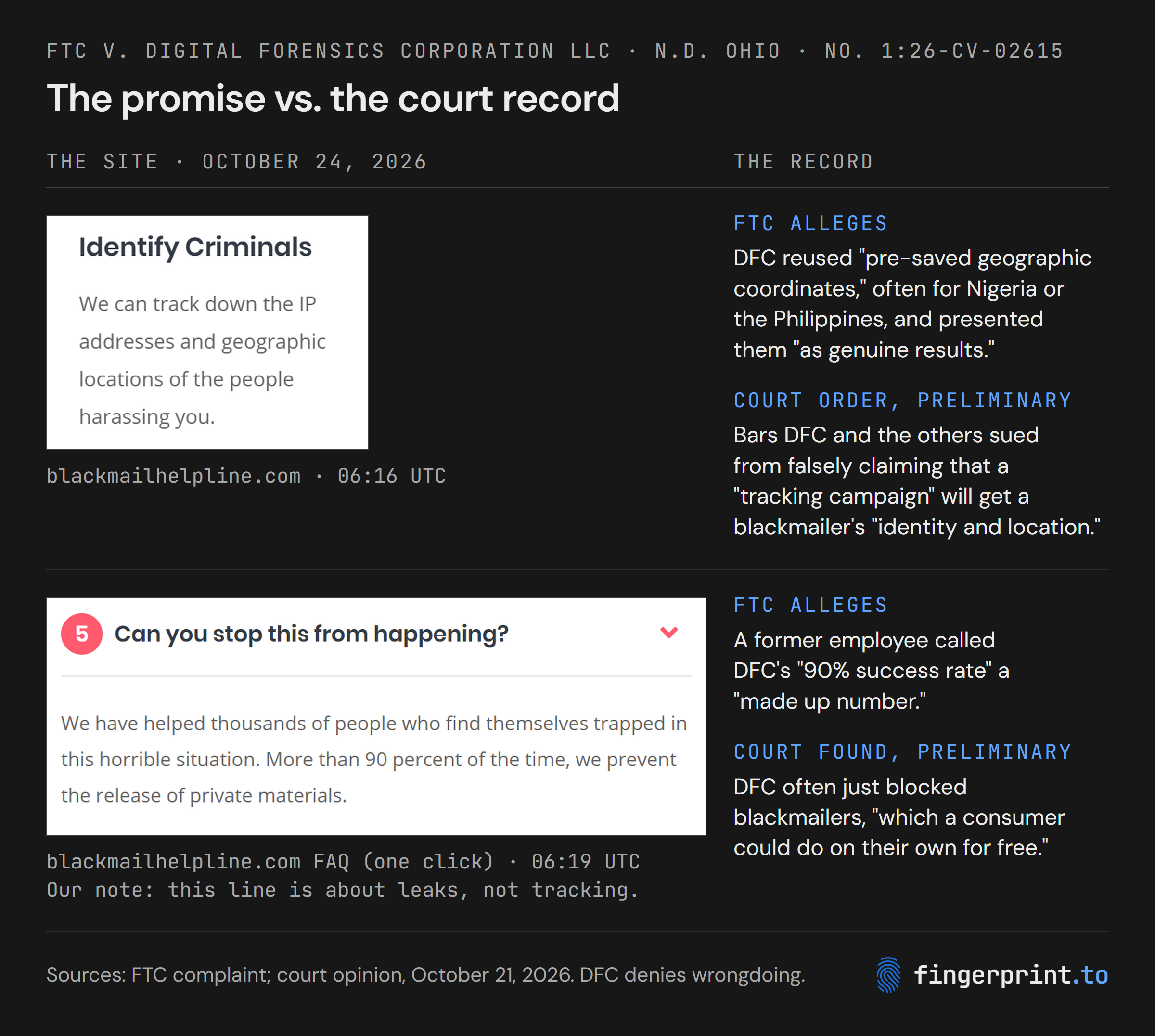
Left: our captures, October 24, 2026, 06:16 and 06:19 UTC. Right: the FTC's complaint and the court's October 21 opinion.
1. The site's "Identify Criminals" box: "We can track down the IP addresses and geographic locations of the people harassing you."
The record: The FTC says DFC's "tracking campaign" was a link meant to reveal a blackmailer's location and IP address. Instead, it alleges, DFC reused "pre-saved geographic coordinates," often for Nigeria or the Philippines, and presented them "as genuine results."
The court order bars DFC and the others sued from falsely claiming that a "tracking campaign" will get a blackmailer's "identity and location."
2. The site's FAQ: "More than 90 percent of the time, we prevent the release of private materials." That's about leaks, not tracking.
The record: A former employee called DFC's "90% success rate" a "made up number," the FTC alleges. DFC says "success" means the blackmailer didn't release the images and stopped the harassment. The judge said that isn't how DFC pitched its services.
What did the judge decide, and what does DFC say?
Judge Patricia A. Gaughan granted a preliminary injunction, an early court order. She found the FTC has "a strong likelihood of succeeding" on its claims about DFC's services and reviews.
A DFC salesperson told an undercover FTC investigator that DFC had a "90% success rate," the judge noted. On tracking, cease-and-desist letters (demands to stop) and police reports, DFC's own figures fall "well short of that mark," she wrote.
Those figures show DFC got details identifying suspects, or people linked to them, in only 32.9% of sampled cases. Without those details, the judge reasoned, it couldn't send a genuine letter or report the blackmailer to police.
A receiver, a court-chosen money manager, stays in place, and the money and property stay frozen. But "legitimate business operations" can continue. If the business can't run without breaking the order, she wrote, it "should not be operating at all."
USA TODAY investigated DFC in March 2025.
DFC denies wrongdoing. It says blackmailers file many of its negative reviews, and that it addressed the "lion's share" (most) of complaints.
What can a username, email or phone lookup do?
We make Fingerprint, online investigation software for private and fraud investigators.
| Can | Can't |
|---|---|
| Find accounts tied to a username, email or phone | Trace an IP address (we have no IP search) |
| Show what profiles display, like a name, photo or listed location | Trace a device's location, or prove who runs an account |
| Show what your own accounts expose | Stop images spreading, or make a blackmailer stop |
Blackmailers can just open new accounts. The FTC says DFC's customers often heard from them again "through new communication platforms or different phone numbers."
FAQ
Is Digital Forensics Corp legit?
On October 21, 2026, a federal judge found the Federal Trade Commission (FTC) likely to win its case against Digital Forensics Corporation LLC (DFC). DFC is based in Warrensville Heights, Ohio. The ruling is early, and its findings are not binding at trial.
The FTC alleges DFC misled sextortion victims about tracking their blackmailers and bought fake reviews, including from Uber drivers. It says DFC charged victims $1,499 to $20,000 for its first phase of help.
The FTC alleges consumers paid DFC and related companies at least $60 million from February 2023 to July 2026. It told the court it received complaints from 847 consumers about DFC's services between February 1, 2023 and September 28, 2026.
DFC denies wrongdoing, and the case, No. 1:26-cv-02615 in federal court in Ohio, is still pending. Police, the FBI and the National Center for Missing & Exploited Children (NCMEC) help sextortion victims for free.
Is Blackmail Helpline part of Digital Forensics Corp?
The Federal Trade Commission (FTC) says so. It says Digital Forensics Corporation LLC (DFC) and related companies it sued run BlackmailHelpline.com, DigitalForensics.com, CyberBlackmail911.com and SecurityBreach911.com, among other sites.
The FTC says newer customer contracts use the name "Blackmail Helpline." It argues the companies now sell the same service under that name, likely to escape DFC's negative online reputation.
On October 24, 2026, BlackmailHelpline.com still promised to track down blackmailers' IP addresses, with no notice about the case. An archived copy shows CyberBlackmail911.com making the same promise in September 2020.
The court has allowed "legitimate business operations" to continue. DFC denies wrongdoing, and the case is pending.
What should I do if I'm being sextorted?
It's not your fault. Report the account in the app and block it, but don't delete your messages or profile. Don't pay or send more images, and tell someone you trust.
Report it to the FBI at tips.fbi.gov or 1-800-CALL-FBI (1-800-225-5324), or to local police. If you're under 18, report it to the CyberTipline of the National Center for Missing & Exploited Children (NCMEC): report.cybertip.org or 1-800-843-5678. The FBI warns against for-profit companies that charge sextortion victims for help.
For images taken before you turned 18, NCMEC's free Take It Down tool can help remove them. For later ones, use StopNCII.org.
You can also ask the site or app to remove an image. Under the TAKE IT DOWN Act, the site or app has 48 hours. If it doesn't act, you can report it at TakeItDown.ftc.gov.
If you're thinking about hurting yourself, call or text 988.
Can Fingerprint find out who is blackmailing me?
No. Fingerprint is online investigation software that finds accounts linked to a username, email address or phone number. It has no IP search, and it can't trace a device's location, prove who runs a throwaway account or stop images spreading.
Don't pay anyone, including Fingerprint, to track a blackmailer. Block the account, keep the evidence and report it to the FBI at tips.fbi.gov or 1-800-CALL-FBI (1-800-225-5324). If you're under 18, also report it to the National Center for Missing & Exploited Children (NCMEC) at report.cybertip.org.
If you're an adult, Fingerprint can help you check what your own accounts reveal.
What could a blackmailer see about you?
The FBI says predators sometimes threaten young victims with screenshots of their followers, friends and family.
Once safe, adults can run their own username, email and phone number, then lock down what links them to family or work. Our digital footprint guide shows how.
Under 18? Ask a trusted adult to help you check your privacy settings.
Don't pay anyone, including us, to track a blackmailer. Real help is free. The only person you need to look up is you.