On this page20 sections
- Fingerprint.to at a glance
- What you can search
- Username search
- Email search
- Phone search
- People Search (U.S.)
- What a result looks like
- Deep Search: follow the lead automatically
- Why you can try it for free
- Pricing
- How Fingerprint.to compares
- Who uses Fingerprint.to
- Responsible by design
- FAQ
- Is Fingerprint.to free?
- How long does a search take?
- What's the difference between Pro and Max?
- Is Fingerprint.to legal to use?
- Can I remove my information?
- Try it
Fingerprint.to is an OSINT (open-source intelligence) search engine. You enter a username, email address or phone number, and it checks that identifier against hundreds of public websites and services at once. It streams back every account it finds, along with the profile details those accounts make public. A typical search finishes within 20 seconds, and you can try it without signing up or adding a card.
This post covers what it searches, what a result looks like, what's free, what the paid plans add, and how it compares to OSINT Industries and Epieos.
Fingerprint.to at a glance
| Fingerprint.to | |
|---|---|
| Search types | Username, email, phone, plus People Search for U.S. name lookups |
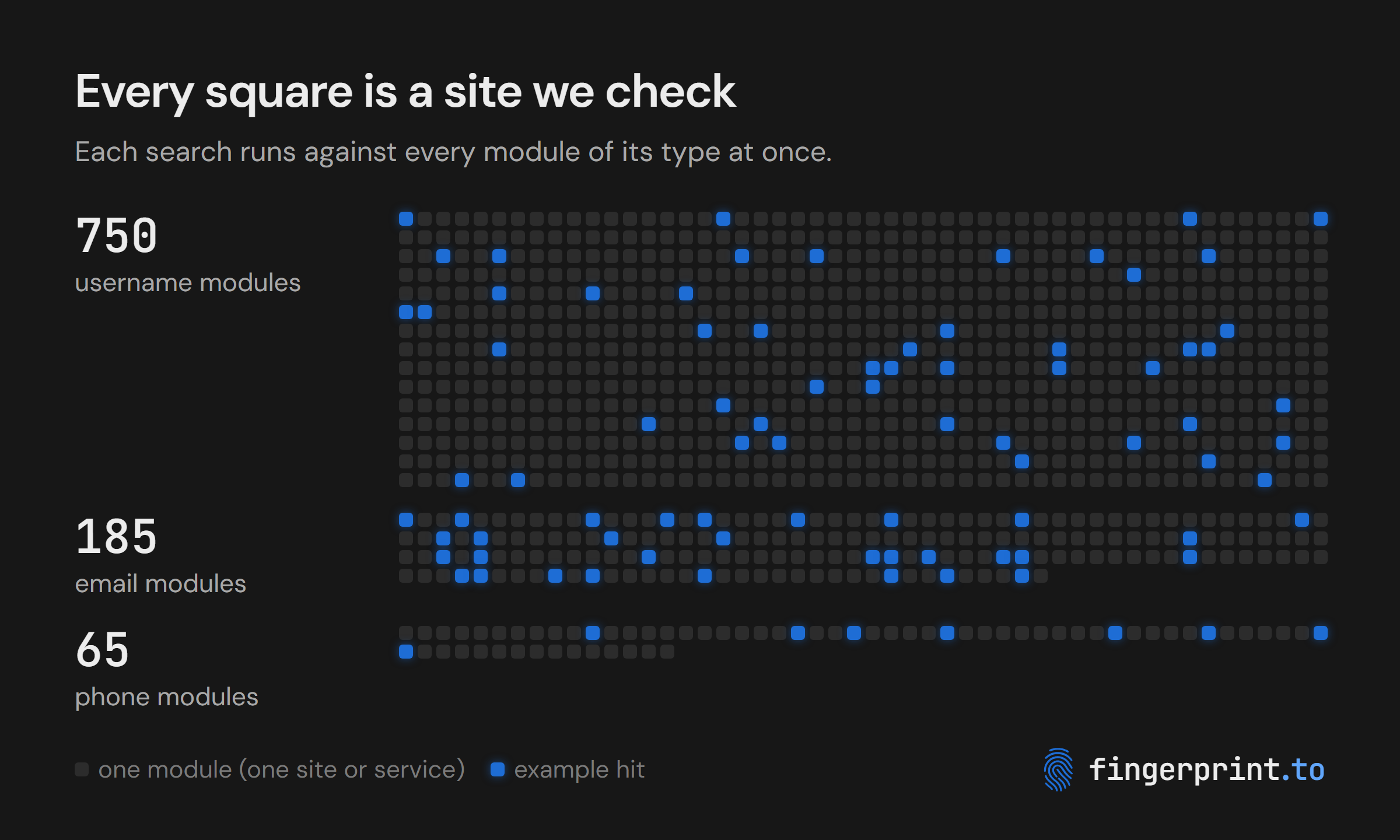
| Coverage | 750 username modules, 185 email modules, 65 phone modules |
| Speed | A typical search finishes within 20 seconds, with results streaming in live |
| Free access | A public demo with no signup, plus a free account with a monthly allowance |
| Paid plans | Pro: $30/month for 500 searches. Max: $100/month for 2,500 searches |
| Data handling | Public sources only. Search results aren't stored, and personal data isn't sold |
Module counts as of October 2026. New modules ship every week.
What you can search
A module is one check, written for one website or service. It doesn't just ask "does this account exist?" It reads the public profile and pulls out the fields that matter: display name, location, join date, last activity and more.
Username search
Usernames are where Fingerprint goes deepest. A single username search runs against 750 modules in parallel. They cover social networks, developer communities, gaming platforms, payment apps, forums and creator sites. People reuse handles across years and platforms, so one username often leads to a whole trail of accounts. We showed how far that can go in how payment apps expose real names.
Email search
An email search checks 185 services for accounts tied to that address and pulls whatever public profile data comes back. It's useful for working out whether an address is a real person's long-term inbox or a throwaway.
Phone search
A phone search runs a number through 65 modules. More than 40 of them are apps that return the name attached to the number. That's often the quickest way to put a name to an unknown caller or a marketplace seller.
People Search (U.S.)
Signed-in users can also look up U.S. records by name, address, email or phone. Full People Search profiles are included on paid plans.
What a result looks like
Every hit appears as a card as soon as its module confirms it. You don't wait for the whole search to finish. Each card shows the platform plus whatever the profile makes public: avatar, display name, bio, location, follower counts, when the account was created and when it was last active.
Free and paid users see the same results. Paid plans unlock the last layer of detail:
| Free & demo | Pro & Max | |
|---|---|---|
| Which platforms have a matching account | ✓ | ✓ |
| Display name, avatar, bio, location | ✓ | ✓ |
| Account created and last active dates | ✓ | ✓ |
| Search history (with a free account) | ✓ | ✓ |
| Direct links to each profile | Locked | ✓ |
| Extra fields (e.g. former usernames) | Locked | ✓ |
| Exports: PDF report, CSV, JSON, text | Locked | ✓ |
| Deep Search | Locked | Max only |
The free tier answers the real question, where does this identity exist? Paid plans are for people who need to click through, export and build a case file.
Deep Search: follow the lead automatically
Investigations rarely stop at one handle. Someone searches bob and finds an Instagram bio that links to bob.john, a GitHub profile under bobjohn92, and a Linktree with two more handles. Normally you'd run five more searches by hand.
Deep Search on the Max plan does that for you. Usernames and emails found in your results get searched automatically across every module. Each layer costs one extra search in total, not one per handle, so a single layer can cover five new usernames for the price of one search.
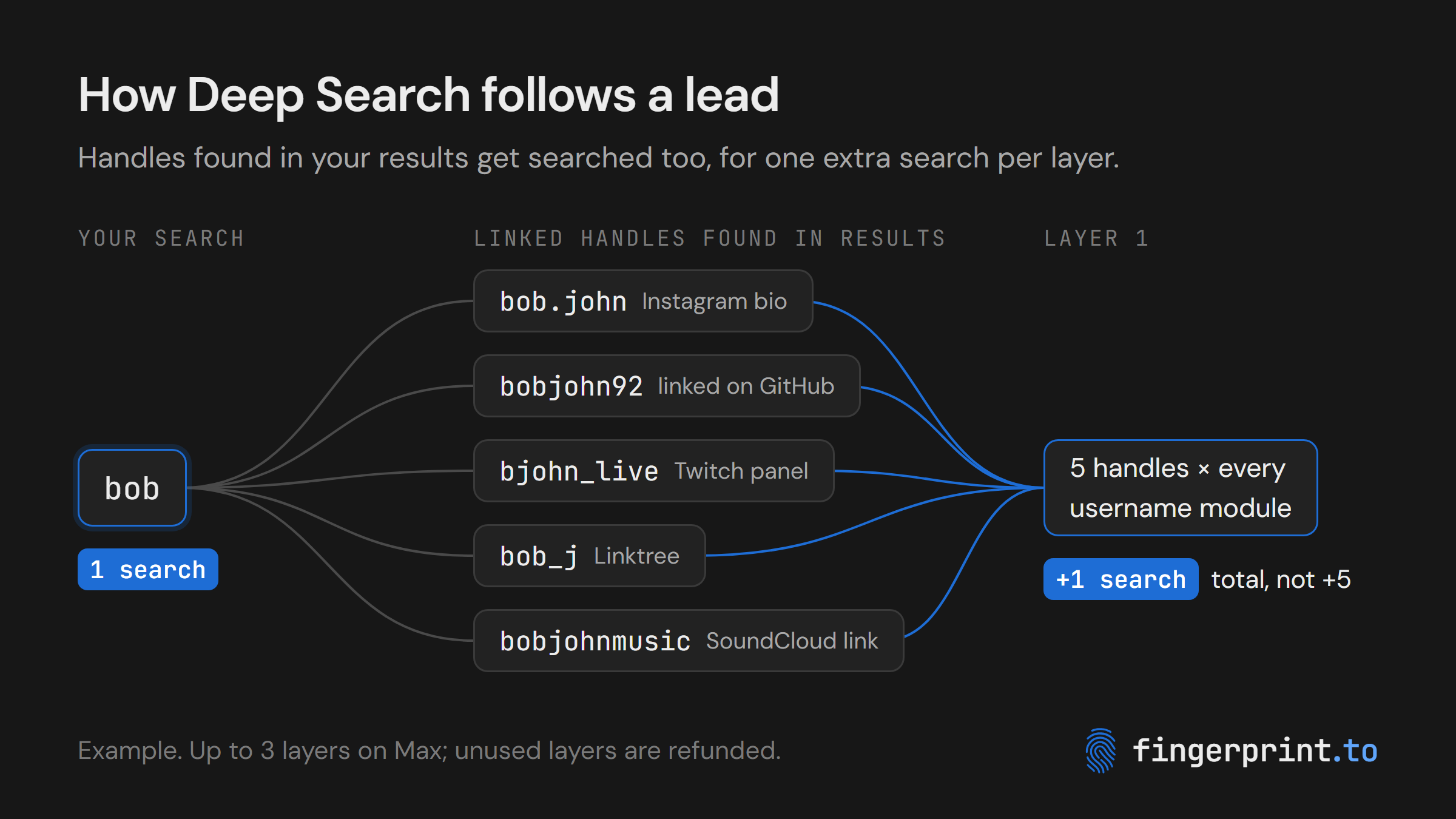
- Up to 3 layers deep. Choose whether to follow usernames, emails or both.
- Refunds for unused layers. If a layer finds nothing new to search, you get that search back.
- Leads, not proof. A linked handle is a lead. It doesn't prove the same person owns every account, which is why the app labels Deep Search as experimental. Verify before you conclude.
Why you can try it for free
Most OSINT platforms don't let the public run real searches for free. Every search costs real infrastructure money, and an open free tier gets scraped or resold almost immediately. That's why many tools in this space reserve trials for vetted customers.
We spent a lot of engineering time on bot detection, rate limiting and abuse controls so we could do the opposite:
- The demo runs live username, email and phone searches. No account, no card.
- A free account adds a monthly search allowance and search history.
Free limits vary by region and change as we tune them, but some form of free access is a permanent part of the product. You should be able to see what a tool actually finds before you pay for it.
Pricing
| Plan | Price | Searches | What it adds |
|---|---|---|---|
| Free | $0 | Demo + monthly allowance | Core profile fields, search history |
| Pro | $30/month | 500/month | Profile links, extra fields, full People Search profiles, exports |
| Max | $100/month | 2,500/month | Everything in Pro, plus Deep Search, priority support, early access |
| Enterprise | Custom | 2,500+/month | SSO/SAML, custom integrations, dedicated account manager, API (coming soon) |
There are no overage charges, and searches that fail or get cancelled before results arrive are refunded. Full details are on the pricing page.
How Fingerprint.to compares
Here's a straight comparison with the best-known paid alternative, using each company's public pricing as of October 2026:
| Fingerprint.to | OSINT Industries | |
|---|---|---|
| Entry plan | $30/mo for 500 searches | £19/mo for 30 credits |
| Top self-serve plan | $100/mo for 2,500 searches | £99/mo for 300 credits |
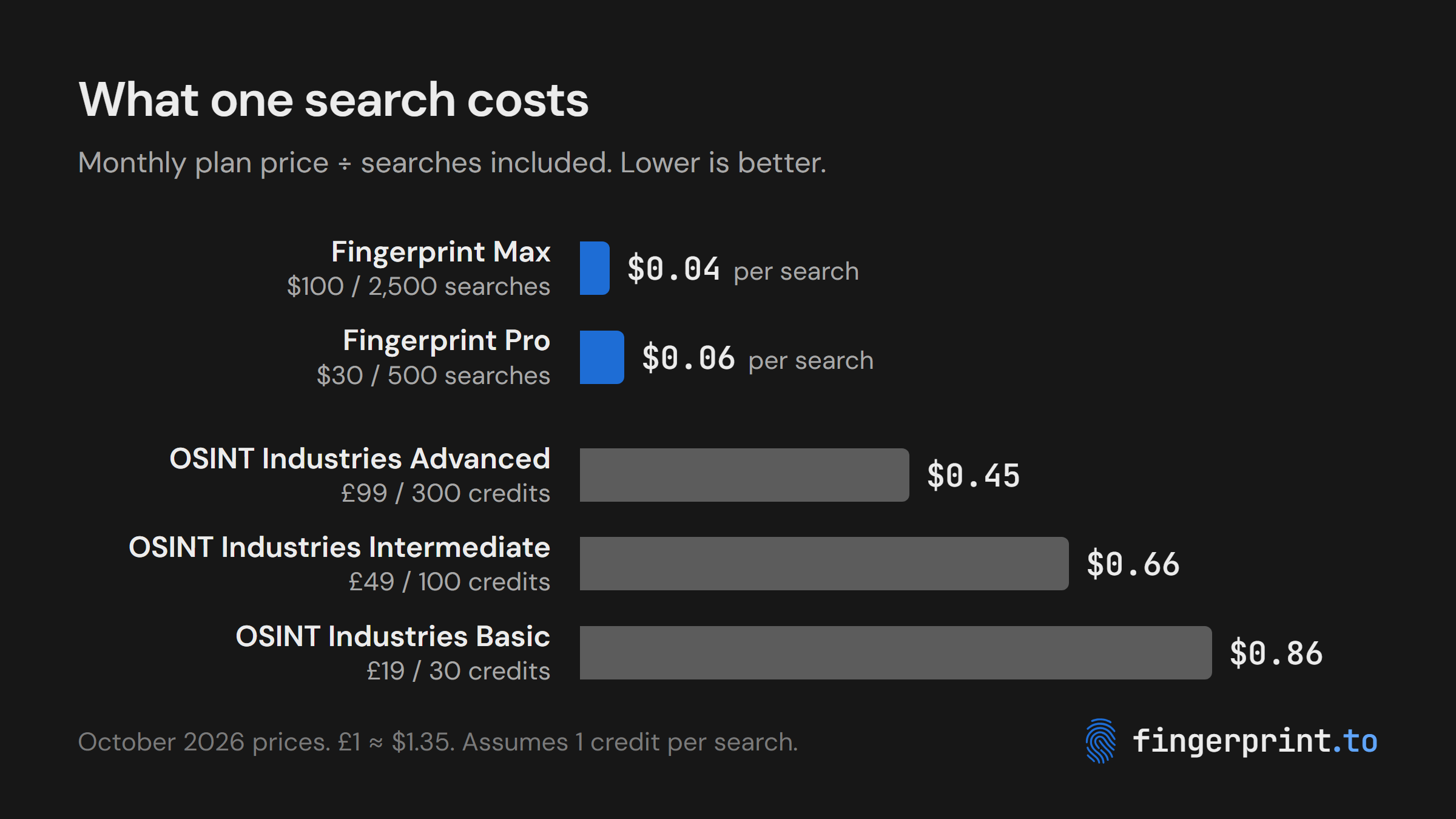
| Cost per search (top plan) | $0.04 | ~$0.45 |
| Try before you pay | Public demo, no signup or card, plus a free account allowance | Free trial for "eligible parties" |
| Search types | Username, email, phone, U.S. People Search | Email, phone, username, name, crypto wallet, IP, domain, image |
| API | Coming soon (Enterprise) | Included from the Intermediate plan |
| Unused allowance | Resets monthly | Credits carry over |
Where Fingerprint.to wins: price per search (roughly 10× cheaper on the top plans), free access for anyone, username depth, and Deep Search at a flat cost per layer.
Where OSINT Industries is ahead: more search types (crypto wallets, IPs, domains and images), an API available today, credits that don't expire monthly, and free-access programs for government, law enforcement, journalists and non-profits. If you need those things, it's a strong tool.
Epieos focuses narrowly on email and phone lookups. Its best-known feature, Google account lookups, is also available free in GHunt, one of the most popular open-source OSINT tools on GitHub. You can get that part without a subscription.
For a deeper look at the username side, read Fingerprint.to vs OSINT Industries.
Who uses Fingerprint.to
- Private investigators and skip tracers mapping a subject's online presence from a single handle or number
- Fraud and trust & safety teams checking whether a seller, applicant or account holder is who they claim to be
- Journalists and researchers tracing sock puppets, scam networks and coordinated accounts
- People checking their own digital footprint, to find old accounts they forgot about before someone else does
Responsible by design
Fingerprint only queries publicly available data. There's no hacking, no breached databases and no private records. Results are processed on the fly rather than stored in our database, and we sell software subscriptions, not personal data, so Fingerprint is not a data broker.
A match is a research lead, not confirmation of identity. Treat it like any other lead and verify it before acting. If you want your email address excluded from future searches, you can use the opt-out page. It verifies the address with a one-time code, and you don't need an account.
FAQ
Is Fingerprint.to free?
Yes, to start. The demo runs real searches without an account or card, and a free account includes a monthly allowance. Paid plans add profile links, extra fields, exports, more searches and, on Max, Deep Search.
How long does a search take?
A typical search finishes within 20 seconds. Results stream in as each module answers, so you're reading hits long before the search finishes.
What's the difference between Pro and Max?
Pro ($30/month) gives you 500 searches with every result field unlocked. Max ($100/month) gives you 2,500 searches and adds Deep Search, which automatically searches the usernames and emails your results uncover.
Is Fingerprint.to legal to use?
Fingerprint searches publicly available information. How you use the results is governed by our terms and the laws where you live. That matters especially for decisions covered by rules like the FCRA, such as employment, housing or credit.
Can I remove my information?
Fingerprint doesn't store search results. To keep your email address out of future searches, use the opt-out page. For other identifiers, contact us.
Try it
The fastest way to understand Fingerprint is to search yourself. Put your own username into the demo and see how much of your footprint is public.