On this page14 sections
- There's no file on you to delete
- What an opt-out actually does
- A blocked search is a clue
- Fix it at the source instead
- When an opt-out does make sense
- FAQ
- Does opting out of an OSINT tool delete my information?
- Do OSINT search engines store my data?
- Can opting out make me easier to find?
- Why does Fingerprint say "This query has been intentionally blocked"?
- How do I remove my information from OSINT search results?
- Can I opt out of OSINT Industries?
- Should I opt out of data brokers?
- Search before you hide
Before you send an opt-out request to an OSINT search engine, think about it for more than a second. What exactly are you asking it to delete?
With most modern OSINT tools, the answer is nothing, because they don't keep a copy of your profiles to delete. An opt-out doesn't take your information off the internet. It blocks one search term on one website, and it tells anyone who hits the block that they've found something worth digging into.
There's no file on you to delete
Live OSINT platforms like Fingerprint and OSINT Industries don't keep a database of people. When someone searches a username, Fingerprint checks Instagram, X, Snapchat and more than 700 other sites at that moment, and reads whatever the public profile under that name shows: display name, bio, profile picture, linked accounts and profile links.
The results stream to the searcher and aren't saved. Fingerprint does log the searches people run (the query, its type and how many results came back, as our privacy policy says), but not the profiles those searches return. OSINT Industries describes its platform the same way, promising "real-time data retrieval" and saying "we never store search results."
So your profiles don't live with us. They live on the platforms, and every one of these tools reads the same public pages. A live OSINT tool is closer to a browser with 700 tabs open at once than to a filing cabinet.
That's the difference from a data broker. People-search sites and data brokers compile records about you and keep them, so an opt-out there removes something real.
Everything in this post is about username, email and phone searches. Fingerprint's U.S. People Search is a different kind of lookup: it shows records supplied by third-party people-search providers, so for names and addresses, the data broker advice further down is what counts.
What an opt-out actually does
On Fingerprint, opting out an email adds it to a blocklist. From then on, anyone who types that exact address gets a block message instead of results. That's all it does:
- Your profiles don't change. Whatever your accounts show publicly, they keep showing.
- Other searches still find you. Say your email is in your Instagram bio, and you opt that email out. Someone searches your Instagram username instead, your profile comes back, and the email is right there in the bio.
- Every other tool still works. OSINT Industries doesn't offer an opt-out for people being searched: its privacy policy covers only people using its website. Open-source tools like Sherlock and Maigret run on the searcher's own computer, so there's nobody to send an opt-out to at all.
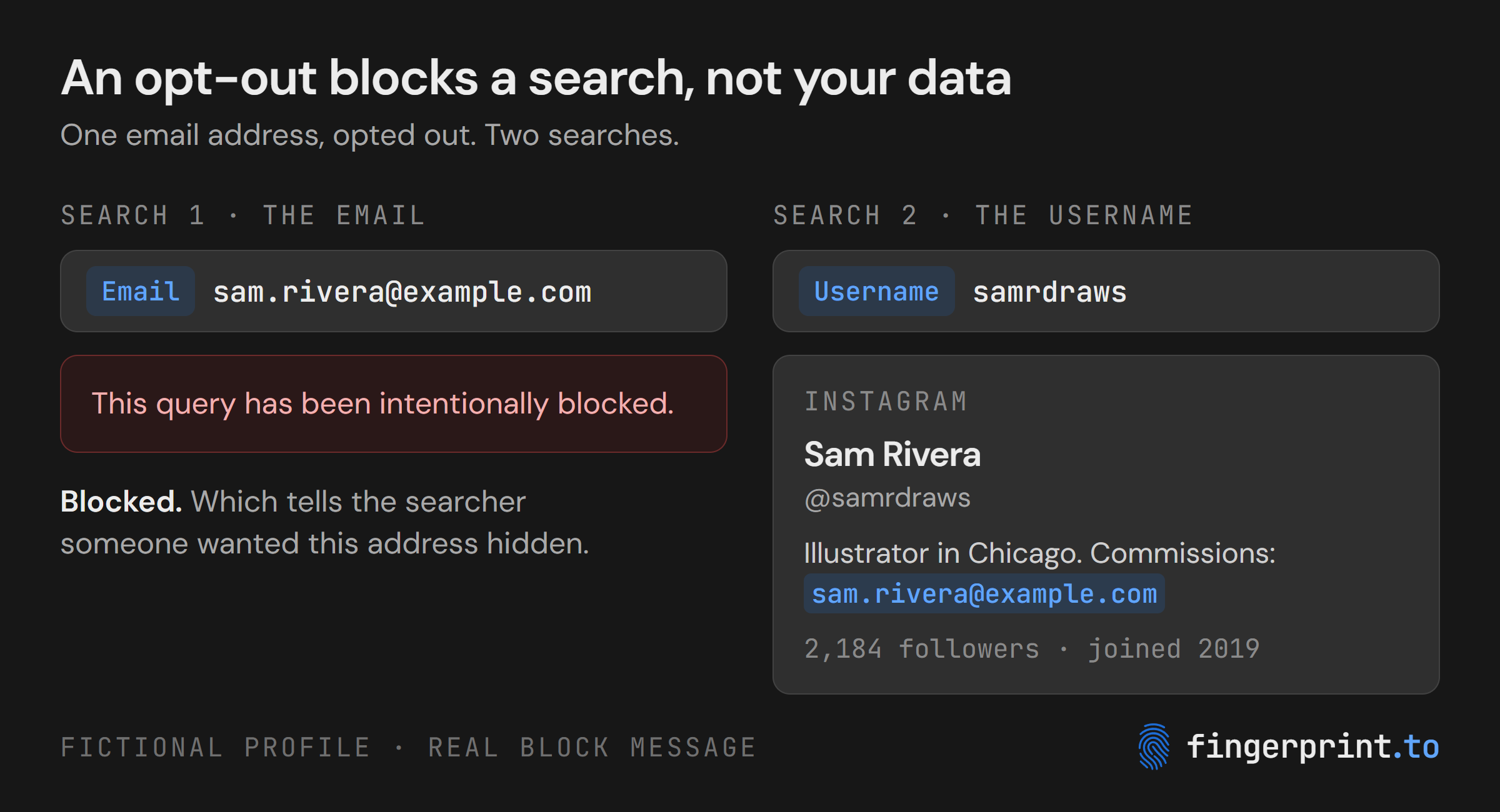
A fictional profile. The block message is the exact wording Fingerprint shows for an opted-out email.
A blocked search is a clue
When someone searches you and gets "This query has been intentionally blocked," they're unlikely to conclude there's nothing there. More likely, they'll take it as a sign they've typed the right thing. Nobody opts out an address they don't use.
A casual searcher gets curious. A determined one opens the next tool and finds the same profiles, because those profiles never went anywhere. If someone is set on finding out who you are, they'll find it whether or not it's on Fingerprint.
We could hide opt-outs behind an empty results page instead. We don't, on purpose. If someone searches a username they know is on a profile and gets zero results, the obvious conclusion is that the tool can't find things. We're not going to make Fingerprint look broken because someone opted out instead of cleaning up their profiles. So the searcher gets the honest answer: the search was blocked, not empty.
Fix it at the source instead
Every OSINT tool, ours included, only reports what a platform publishes right now. Change what the platform publishes and you disappear from every live search tool at once, including the ones you've never heard of.
So use the tools on yourself, the way an investigator would:
- Search every handle, email and phone number you've used. Our digital footprint guide walks through it, and the demo runs real searches with no signup.
- Note what each result exposes: a real name next to an anonymous handle, a city, a phone number, an email in a bio, or a link that ties one account to another.
- Log in and change it. Edit the display name, clear the bio, remove the links and location, or change the username entirely. Delete the accounts you don't use.
- Turn off "find me by phone or email" in the apps that offer it. That setting is what lets a phone search match you.
- Can't get in? Use the platform's account recovery or its privacy request form. Instagram, Snapchat and X hold the data, so they're the ones who can remove it.
Then search again. When the profile changes, every live tool's result changes with it. Copies made before you changed anything don't update themselves: archived pages and data broker records stay as they were, which is where removal requests come in.
One caveat: renaming isn't always erasing. Some platforms, including Roblox and Bluesky, keep a public history of former usernames, so check whether an old handle is still attached after you change it.
When an opt-out does make sense
Opt-outs are worth it where data is actually stored:
- Data brokers and people-search sites keep records about you, so removal takes something real offline. The FTC recommends opting out of them site by site and checking back periodically, because records can reappear. California residents can use the state's DROP platform to send one deletion request to every registered data broker, and brokers have had to process those requests, with limited exemptions, since August 1, 2026.
- Search engines. Google's Results about you finds Google results that show your phone number, email or home address and lets you request their removal. The page itself stays up, but it gets much harder to stumble on.
- Email-finder databases like Hunter.io crawl public web pages and store the work emails they find. Hunter's privacy policy says it keeps each one until it disappears from the source page or you remove it through its claim page, so that opt-out deletes a stored record.
- As a last step on a live tool, after the clean-up. If there's an old account you truly can't recover or delete, blocking it from searches is better than nothing.
We don't store the profiles we find, and OSINT Industries, a London company that says it's subject to both UK and EU GDPR, offers no opt-out for searched people at all. Fingerprint offers one anyway. Our opt-out page blocks an email the moment you verify it, and usernames, phone numbers and names go through the contact page. We'll honor it. We'd just rather you run the search first, because that's the part that actually protects you.
FAQ
Does opting out of an OSINT tool delete my information?
No. Live OSINT tools like Fingerprint and OSINT Industries don't store the profiles they find, so there's nothing to delete. An opt-out only blocks your identifier as a search term on that one site. Your public profiles stay online, and other tools can still find them.
Do OSINT search engines store my data?
Live ones don't store search results. Fingerprint checks each platform at the moment of the search and returns what the public profile shows, and OSINT Industries says it never stores search results. Fingerprint does log the searches people run, but not the profiles those searches return. Data brokers and people-search sites are different, because they compile and keep records.
Can opting out make me easier to find?
It can. A searcher who sees "This query has been intentionally blocked" learns that the identifier is real and that someone wanted it hidden. That can send them to another tool, where the same public profiles still show up.
Why does Fingerprint say "This query has been intentionally blocked"?
Because the identifier was opted out or blocked, and an empty results page would wrongly suggest the tool found nothing. Fingerprint tells the searcher the search was blocked rather than pretending the profiles don't exist. The profiles themselves are untouched and can still be found through other searches and other tools.
How do I remove my information from OSINT search results?
Change it at the source. Search your own usernames, emails and phone numbers, then log in to each account and remove what you don't want public, change the username, or delete the account. Once the platform stops showing it, live OSINT tools stop finding it. Archived copies and data broker records need their own removal requests. If you can't get into an account, contact the platform itself.
Can I opt out of OSINT Industries?
OSINT Industries doesn't offer an opt-out for people being searched. Its privacy policy covers only people who use its website, and it says it never stores search results, so there would be nothing to delete anyway. To stop showing up there, and in every other live tool, change or remove the information on the platforms it searches.
Should I opt out of data brokers?
Yes. Data brokers keep records about you, so an opt-out removes something real. California residents can send one deletion request to every registered broker through the state's DROP platform. The same goes for email-finder databases like Hunter.io, which store the work emails they crawl and let you remove yours through a claim page.
Search before you hide
The opt-out form is the last step, not the first. Put your handle into the demo, see what's out there, and fix it where it lives.